Agenta vs OpenMark AI
Side-by-side comparison to help you choose the right tool.

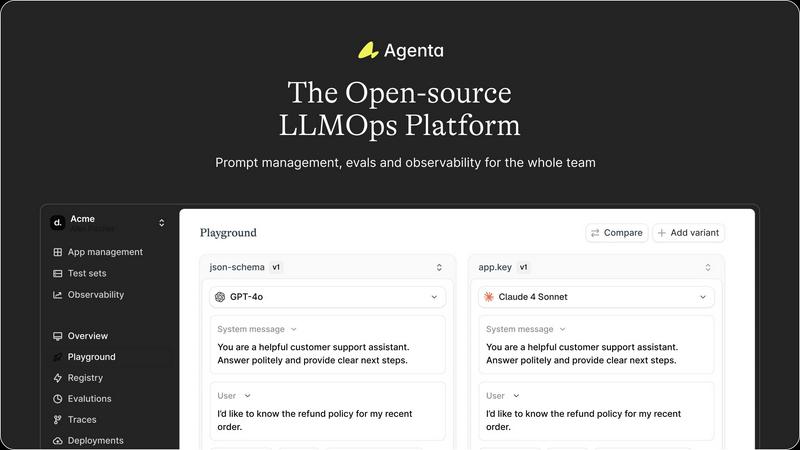
Agenta is an open-source platform that helps teams build and manage reliable AI apps together.
Last updated: March 1, 2026

OpenMark AI lets you benchmark over 100 LLMs for your specific tasks, providing insights on cost, speed, quality, and stability in minutes.
Last updated: March 26, 2026
Visual Comparison
Agenta
OpenMark AI
Feature Comparison
Agenta
Unified Playground
Agenta provides a unified playground where you can safely experiment with different prompts and models side-by-side in one central interface. This eliminates the need to juggle multiple tools or windows. Found an error in production? You can easily save it to a test set and use it directly in the playground to debug and iterate, making prompt engineering a collaborative and data-driven process.
Automated Evaluation
Replace guesswork with evidence using Agenta's systematic evaluation framework. You can create automated tests to validate every change to your LLM application. The platform supports any evaluator you need, including LLM-as-a-judge, built-in metrics, or your own custom code. Crucially, you can evaluate the full trace of an agent's reasoning, not just the final output, to pinpoint exactly where things go right or wrong.
Comprehensive Observability
Gain full visibility into your live AI applications with detailed tracing for every request. This allows you to quickly debug systems and find the exact failure points when things go wrong. You can annotate traces with your team or gather feedback from users directly within the platform. Any trace can be turned into a test case with a single click, creating a powerful feedback loop.
Team Collaboration Hub
Agenta breaks down silos by providing a shared workspace for your entire team. It offers a safe, no-code UI for domain experts to edit and experiment with prompts. Product managers and experts can run evaluations and compare experiments directly from the interface, while developers work via the full-featured API. This parity between UI and API workflows brings everyone into one cohesive development process.
OpenMark AI
Task Configuration
OpenMark AI offers an intuitive task configuration interface, allowing users to describe their benchmarking tasks in plain language. You can choose between simple or advanced settings, making it easy for users of all skill levels to get started without technical expertise.
Real-time Comparisons
With OpenMark AI, users can run real API calls to a wide variety of models in one session. This feature ensures that the results you see are based on actual performance rather than cached metrics, providing a trustworthy basis for decision-making.
Cost Efficiency Analysis
The platform emphasizes the importance of cost efficiency, enabling users to assess the true cost of each API call. This feature helps teams make informed decisions that balance quality and affordability, ensuring that budgetary constraints are met without sacrificing performance.
Consistency Tracking
OpenMark AI enables users to evaluate the consistency of model outputs by running the same tasks multiple times. This feature is crucial for understanding whether a model can reliably deliver similar results, which is essential for applications where stability is a priority.
Use Cases
Agenta
Streamlining Prompt Engineering Workflows
Teams can centralize their prompt development, moving away from scattered documents in Slack, Google Sheets, and emails. With version history and side-by-side comparison, developers and domain experts can collaboratively iterate on prompts, test them with real data, and track all changes systematically, leading to more reliable and performant prompts.
Running Rigorous LLM Application Tests
Before deploying any change, teams can establish a rigorous evaluation process. They can build test sets from production errors, use automated evaluators (like LLM judges) to score outputs, and integrate human feedback from experts. This ensures every update is backed by data, preventing performance regressions and "vibe testing" before going to production.
Debugging Complex AI Agents in Production
When a multi-step AI agent behaves unexpectedly in a live environment, Agenta's observability tools shine. Engineers can trace every step of the agent's reasoning chain, annotate where failures occurred, and immediately use those problematic traces to create new test cases. This turns painful guesswork into a structured debugging workflow.
Enabling Cross-Functional AI Development
Agenta empowers non-technical team members to contribute directly to the AI development lifecycle. Product managers can define evaluation criteria and run tests, while subject matter experts can tweak prompts in a safe UI environment without writing code. This collaboration accelerates iteration and ensures the final product aligns with business and domain expertise.
OpenMark AI
Model Selection for AI Features
Developers can use OpenMark AI to compare different models for specific AI features they plan to implement. By benchmarking various options, teams can identify the model that best meets their requirements for performance and cost.
Pre-deployment Testing
Before launching any AI-driven application, product teams can leverage OpenMark AI to conduct thorough pre-deployment testing. This ensures that the selected model behaves as expected in real-world scenarios, reducing the risk of post-launch issues.
Quality Assurance in AI Outputs
Quality assurance teams can utilize OpenMark AI to systematically evaluate and compare the outputs of different models. This ensures that the chosen model consistently meets the quality standards necessary for the intended application.
Research and Development
Researchers exploring new algorithms or model architectures can use OpenMark AI to benchmark their creations against existing models. This allows for a clearer understanding of how new developments stack up in practical applications.
Overview
About Agenta
Agenta is your friendly, open-source platform designed to help teams build and ship reliable AI applications powered by large language models (LLMs). If you've ever felt frustrated by the unpredictable nature of LLMs, with prompts scattered everywhere and debugging feeling like guesswork, Agenta is here to help. It's built for the whole team-developers, product managers, and subject matter experts-to collaborate seamlessly. The platform acts as your single source of truth, centralizing the entire LLM development workflow. You can experiment with different prompts and models, run automated evaluations to replace gut feelings with hard evidence, and observe your live applications to quickly pinpoint issues. By bringing everyone together and providing the right tools, Agenta transforms chaotic, siloed processes into a structured, efficient practice known as LLMOps, helping you move from experimentation to production with confidence. Whether you're a developer tired of manual testing or a product manager needing visibility into AI performance, Agenta provides the integrated infrastructure for prompt management, evaluation, and observability you need to succeed.
About OpenMark AI
OpenMark AI is a powerful web application designed specifically for task-level benchmarking of large language models (LLMs). It allows users to define tasks in plain language, run tests on various models simultaneously, and analyze crucial metrics such as cost per request, response latency, scored quality, and output consistency across multiple trials. This approach helps users see the variance in model outputs rather than relying on a single, potentially misleading result. OpenMark AI is targeted at developers and product teams who need to select or validate AI models before integrating them into their products. By utilizing hosted benchmarking that operates on credit-based access, users eliminate the hassle of managing multiple API keys from providers like OpenAI, Anthropic, or Google. With OpenMark AI, you can achieve efficient cost management by comparing the quality of outputs relative to their price, making it easier to choose the right model for specific workflows without the need for extensive setup.
Frequently Asked Questions
Agenta FAQ
Is Agenta really open-source?
Yes, Agenta is fully open-source. You can dive into the code on GitHub, contribute to the project, and self-host the platform. This gives you full control over your data and infrastructure while benefiting from a tool built and vetted by a community of hundreds of AI builders.
What AI frameworks does Agenta work with?
Agenta is designed to be flexible and model-agnostic. It seamlessly integrates with popular frameworks like LangChain and LlamaIndex, and works with models from any provider, including OpenAI, Anthropic, and open-source models. This prevents vendor lock-in and lets you use the best model for each task.
How does Agenta help with collaboration?
Agenta provides a single platform that serves both technical and non-technical team members. It offers a no-code UI for experts to edit prompts and run evaluations, while providing a full API for developers. This shared "source of truth" for prompts, tests, and traces ensures everyone is aligned and can contribute effectively.
Can I use Agenta to monitor live applications?
Absolutely. Agenta's observability features allow you to trace every request to your live LLM application. You can monitor performance, detect regressions with online evaluations, and gather user feedback on specific outputs. This continuous oversight is crucial for maintaining and improving reliable AI systems in production.
OpenMark AI FAQ
How does OpenMark AI handle multiple APIs?
OpenMark AI simplifies the benchmarking process by managing API calls for you. There is no need to configure separate API keys for each model, which saves time and reduces setup complexity.
Can I use OpenMark AI for free?
Yes, OpenMark AI offers both free and paid plans. Users can sign up to receive 50 free credits, allowing them to explore the platform’s capabilities without any initial investment.
What types of tasks can I benchmark?
OpenMark AI supports a wide variety of tasks, including but not limited to classification, translation, data extraction, research, and Q&A. This flexibility makes it suitable for diverse applications across industries.
How does OpenMark AI ensure the accuracy of its results?
OpenMark AI runs real API calls to the models being tested, ensuring that the results reflect actual performance. This approach eliminates reliance on potentially misleading marketing claims and provides users with reliable data for making informed decisions.
Alternatives
Agenta Alternatives
Agenta is an open-source platform in the LLMOps category, designed to help teams build and manage reliable AI applications. It centralizes the workflow for experimenting with prompts, evaluating models, and observing live apps, making collaboration between developers and non-technical team members much smoother. People often explore alternatives to Agenta for various reasons. They might need a different pricing model, require specific integrations with their existing tech stack, or look for a tool that offers a different set of features or a different user experience. It's a natural part of finding the perfect fit for a team's unique workflow and budget. When choosing an alternative, focus on what matters most for your project. Consider the platform's core capabilities for experimentation and evaluation, how well it supports team collaboration, and its approach to security and data privacy. The goal is to find a solution that brings structure to your AI development process, helping your team move from ideas to production with confidence.
OpenMark AI Alternatives
OpenMark AI is a powerful web application designed for benchmarking large language models (LLMs) at a task level. It allows users to assess over 100 models in terms of cost, speed, quality, and stability, all within a single browser session. This makes it particularly valuable for developers and product teams who need to validate their AI models before integration into their features. Users often seek alternatives to OpenMark AI for various reasons, including pricing, specific feature sets, or compatibility with existing platforms. When considering alternatives, it's important to look for options that provide comprehensive benchmarking capabilities, user-friendly interfaces, and cost efficiency. Ultimately, the right choice will depend on your unique requirements and the specific tasks you aim to accomplish.