StockFit API
StockFit API gives you clean, standardized SEC financial data you can actually use for valuation and backtesting.
Visit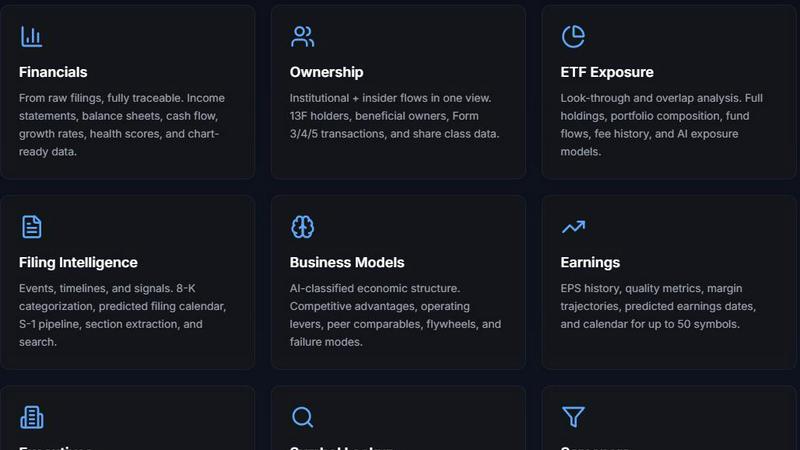
About StockFit API
StockFit API is a powerful financial data tool designed specifically for developers, quants, and research platforms who need direct access to SEC filing data without the usual tradeoffs. Most financial APIs force you to choose between cheap tiers with accuracy issues or expensive enterprise contracts that drain a startup budget. StockFit fills this gap by providing fundamentals, ownership data, ETF and mutual fund exposure, insider transactions, and filings all pulled directly from SEC XBRL data. There is no derived middle layer, so every number you see is traceable back to the original filing. This means you can trust the data for valuation, backtesting, and economic modeling.
The API is built for real world use cases. It handles amended filings correctly, computes non December fiscal years accurately, and reconstructs Q4 data from 10 K plus 10 Q filings. Beyond standard financials, StockFit offers rich economic models per company covering offerings, peers, operating levers, competitive advantages, flywheels, strategic initiatives, and failure modes. For ETF and mutual fund exposure, the models cover mandate, portfolio construction, costs, sensitivities, and use cases. The data is AI friendly for LLM workflows, making it perfect for integration with tools like Claude and Cursor. With over 250 million facts, 5 million filings, and daily updates, StockFit API gives you the financial data you can actually model with.
Features of StockFit API
Standardized Financials with No Taxonomy Drift
StockFit API delivers financial statements that are standardized across all companies and time periods. Unlike other APIs that suffer from taxonomy drift where the same concept gets reported under different labels, StockFit normalizes everything into consistent fields. You get revenue, cost of revenue, gross profit, operating expenses, net income, EPS, and dozens more metrics formatted identically for every company. This consistency is critical for building automated models and backtesting strategies because your code does not need to handle exceptions or mapping tables. Every fact is also tagged with its source filing ID, so you can always trace back to the original SEC document.
Economic Models for Companies and Funds
Beyond raw financial data, StockFit provides rich economic models per company. These models cover offerings, peer comparisons, operating levers, competitive advantages, flywheels, strategic initiatives, and failure modes. For ETF and mutual fund exposure, the models include mandate analysis, portfolio construction details, cost structures, sensitivities, and specific use cases. This structured economic context is AI friendly and designed for LLM workflows. You can feed these models directly into Claude, Cursor, or other AI tools to generate investment research, company analysis, or portfolio insights without additional preprocessing.
Advanced Fiscal Period Handling
StockFit handles complex fiscal period calculations automatically. Many companies have non December fiscal years, and the API computes these correctly without manual adjustment. It also reconstructs Q4 data by combining the annual 10 K filing with the first three quarterly 10 Q filings. This gives you complete quarterly data even when companies only report annual figures in their 10 K. Additionally, amended filings are processed properly, so you always have the most current and accurate data. This feature saves hours of manual data wrangling and ensures your models use the correct time periods.
Massive Data Coverage with Daily Updates
The API provides access to over 250 million individual financial facts drawn from more than 5 million SEC filings. This covers virtually all publicly traded US companies with comprehensive historical data. Updates happen daily, so you always have access to the latest filings and financial information. The data is delivered through a REST API that is simple to integrate, and there is also a native MCP server for direct use with Claude, Cursor, and other AI tools. Whether you need a single company snapshot or a bulk download for backtesting, StockFit scales to meet your needs.
Use Cases of StockFit API
Automated Valuation and Financial Modeling
Analysts and quants can use StockFit API to build automated valuation models. The standardized financials and economic models make it easy to compute discounted cash flow valuations, comparable company analysis, and leveraged buyout models. You can pull historical income statements, balance sheets, and cash flow data for any company, then apply your own valuation formulas. The source cited data ensures every input is verifiable, which is critical for investment committees and audit trails. With daily updates, your models always use the most recent financial information.
Backtesting Quantitative Trading Strategies
Quantitative researchers can leverage StockFit API for rigorous backtesting of trading strategies. The API provides sector aware metrics and standardized financials that align perfectly with factor models. You can test strategies based on value, growth, profitability, or momentum factors using clean historical data. The economic models also help identify companies with competitive advantages or specific operating levers that might predict future performance. Because the data is traceable to original filings, you can validate your backtest results with confidence.
AI Powered Investment Research with LLMs
Developers building AI investment tools can integrate StockFit API directly into LLM workflows. The economic models are designed to be AI friendly, providing structured context about companies and funds that language models can understand and reason about. You can feed company economic models into Claude or Cursor to generate investment theses, competitive analysis, or risk assessments. The MCP server makes this integration seamless, allowing AI tools to query financial data in real time without complex API calls.
Portfolio Construction and Risk Analysis
Asset managers and wealth advisors can use StockFit API to analyze portfolio holdings and risk exposures. The ETF and mutual fund exposure models provide detailed information about mandate, portfolio construction, costs, and sensitivities. You can assess how a fund is positioned relative to its benchmark, understand its sector concentrations, and evaluate its risk factors. The insider transactions data also helps monitor management confidence and potential red flags. This comprehensive view supports better portfolio construction and ongoing risk management.
Frequently Asked Questions
How does StockFit API ensure data accuracy compared to other financial APIs?
StockFit API pulls data directly from SEC XBRL filings without any derived middle layer. Every financial fact is traceable back to its original filing through a unique source identifier. This eliminates the errors that accumulate when data passes through multiple transformation steps. The API also handles amended filings correctly, so you always have the most current version of the data. Additionally, non December fiscal years are computed accurately, and Q4 data is reconstructed from 10 K plus 10 Q filings to ensure completeness.
Can I use StockFit API with AI tools like Claude or Cursor?
Yes, StockFit API provides a native MCP server that works directly with Claude, Cursor, and other AI tools. The economic models for companies and funds are designed to be AI friendly, providing structured context that LLMs can understand and reason about. You can query financial data, company models, and fund exposures through natural language interfaces. This makes it easy to build AI powered investment research tools without complex API integration.
What types of financial data does StockFit API cover?
StockFit API covers a comprehensive range of financial data including standardized financial statements (income statement, balance sheet, cash flow), ownership data, ETF and mutual fund exposure, insider transactions, and SEC filings. The API provides over 250 million individual facts from more than 5 million filings. Economic models per company cover offerings, peers, operating levers, competitive advantages, flywheels, strategic initiatives, and failure modes. ETF and MF exposure models cover mandate, portfolio construction, costs, sensitivities, and use cases.
How often is the data updated and what is the historical coverage?
The data is updated daily, so you always have access to the latest SEC filings and financial information. Historical coverage extends back to the beginning of XBRL filing requirements, providing many years of data for most publicly traded US companies. The API includes over 250 million facts and 5 million filings, giving you extensive historical data for backtesting and long term analysis.